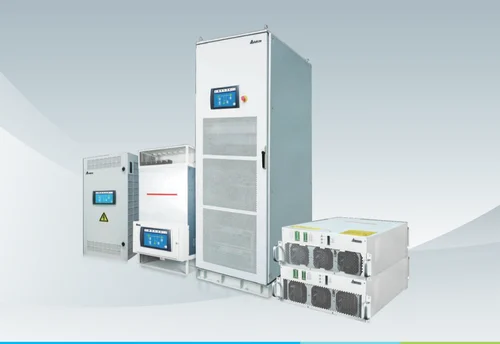
Active Harmonic Filter (AHF)
- An AHF is connected in parallel (shunt) to the electrical system — typically at the point of common coupling (PCC).
- It continuously monitors the load current waveform, detects harmonic components (i.e. frequencies that are integer multiples of the fundamental), and injects compensating currents that are equal in magnitude but 180° out of phase with the harmonic currents — effectively canceling the harmonics and restoring near-sinusoidal currents.
- As a result: harmonic distortion (THDi) is reduced, power factor can improve (since distortion PF is corrected in addition to displacement PF), and three-phase current balance / neutral current compensation is often possible (especially in 4-wire systems).
- AHF are dynamic, fast-responding, and more flexible than traditional passive filters — making them particularly suitable for modern industrial/commercial facilities with varying loads.